Sunday, September 7, 2014
Tuesday, June 24, 2014
Moving Features
To promote easier readability, navigation, and visual appeal, The Real World feature and our student profiles have been moved.
These new pages are still under construction and will soon be merged with the rest of the blog. In the meantime, head on over to their new homes and let us know what you think.
Saturday, June 21, 2014
Emilie Davis’s Civil War Debuts at HSP
On Thursday evening, as part of the Juneteenth celebrations taking place throughout the city, the Historical Society of Pennsylvania celebrated the release of the much-anticipated Emilie Davis’s Civil War. The book is the product of the Memorable Days Project, completed by Villanova’s own Dr. Judy Giesberg and several of her students – Ruby Johnson, Rebecca Capobianco, Theresa Altieri, Tom Foley, and Jessica Maiberger.
The event began with a discussion about the project and what scholars can learn from the diaries. The Memorable Days team took turns reading from the diaries on some of the key themes: emancipation, work, play, worry, and love. Dr. Giesberg then spoke on the importance of the project. As a young woman who worked, studied, and participated in many institutions in Civil War era Philadelphia, Emilie Davis provides a unique perspective on how an African American woman experienced the Civil War. From her concerns about her father being in the path of the Army of Northern Virginia as they moved through Pennsylvania to seemingly trivial things such as the weather or going out for ice cream, Davis’s words reveal important insight into the African American community in Philadelphia during the Civil War.
The team then spoke on the challenges of working on the diaries. Once they overcame the difficulties of transcribing Davis’s handwriting, which was small, abbreviated, and often in now-faded pencil, they had to figure out what she was actually talking about. Names, places, institutions, and events needed to be researched, often going off of merely names or references. While some of the names mentioned remain a mystery, their research unearthed a web of political, religious, and social institutions, as well as a vivid cast of characters that brought life to the African American community of Philadelphia.
After the discussion, the Historical Society held a reception and displayed related documents from their collection. In the addition to the diaries (small, pocket-sized books with even smaller handwriting), the staff exhibited documents from Camp William Penn, the Institute for Colored Youth, and various other documents commemorating emancipation and the fight for equal rights in Philadelphia.
The event was well-attended by interested members of the community, who asked a variety of questions, bought copies of the book, and sought to learn more at the exhibits. The contents of Emilie Davis’s diaries have shed new light on the African American community in Civil War Philadelphia and will hopefully spark new questions for historians to pursue. Congratulations to Dr. Giesberg and the Memorable Days team; the event was a just celebration of their hard work and achievements with the Emilie Davis diaries.
Check out the book at Penn State University Press.
 |
| The Memorable Days Team: (from left-right) Tom Foley, Rebecca Capobianco, Dr. Judy Giesberg, Theresa Altieri, Jessica Maiberger, and Ruby Johnson. |
The team then spoke on the challenges of working on the diaries. Once they overcame the difficulties of transcribing Davis’s handwriting, which was small, abbreviated, and often in now-faded pencil, they had to figure out what she was actually talking about. Names, places, institutions, and events needed to be researched, often going off of merely names or references. While some of the names mentioned remain a mystery, their research unearthed a web of political, religious, and social institutions, as well as a vivid cast of characters that brought life to the African American community of Philadelphia.
After the discussion, the Historical Society held a reception and displayed related documents from their collection. In the addition to the diaries (small, pocket-sized books with even smaller handwriting), the staff exhibited documents from Camp William Penn, the Institute for Colored Youth, and various other documents commemorating emancipation and the fight for equal rights in Philadelphia.
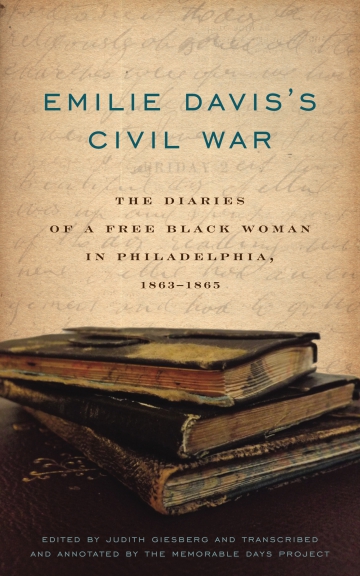 |
| The final product, Emilie Davis's Civil War (Penn State University Press) |
Check out the book at Penn State University Press.
Monday, June 16, 2014
Villanova Students, Graduates, Faculty Attend Civil War Conference in Baltimore
This past weekend, the Society of Civil War Historians held their biennial academic conference in Baltimore.
The conference featured panels on a variety of topics which encouraged participants to think about the Civil War era in new ways. Historians presented papers and led discussions which looked at the war in a number of different ways, such as gender, race, economics, memory, and even international perspectives. From the opening panel “Dwelling in the Archives,” to the concluding one “Waging Peace: The Past, Present, and Future Scholarship on Reconstruction,” the topics promoted lively discussions among historians from the around the country (and world) with a diverse set of interests.
Villanova’s own Dr. Judy Giesberg participated in two panels. For the discussion “Teaching the New Military History,” she presented a paper on ways to bring social and military history into a class on the Civil War. Her presentation included a social history tour of the Gettysburg battlefield, which extends beyond the Union and Confederate armies by looking at how the battle influenced the lives of soldiers and civilians alike.
Dr. Giesberg also presided over the panel “Bodies of War: Material Perspectives on the American Civil War Era.” Here she responded to papers presented on how the legacy of clothing, facial hair, and disability-related humor can influence the ways we think about the Civil War.
Overall the conference sparked lively discussions about the Civil War, as well as the state of present and future scholarship. By looking at new sources or by asking new questions, scholars are demonstrating new ways of thinking about the era, which are culminating in exciting new projects. For a conference novice such as myself, the SCWH event in Baltimore was a great learning experience, not only for the insight on upcoming trends in Civil War scholarship but for getting the feel for academic conferences.
Check out the full agenda here.
Are you doing something history-related this summer? Are you attending a conference, presenting a paper, traveling for research, or have an interesting job? We would love for you to share. Contact us and tell us all about it.
 | ||
| Villanova at the SCWH Conference: Mike Johnson, Dr. Giesberg, Eileen Brumitt, and Jim Kopaczewski |
Villanova’s own Dr. Judy Giesberg participated in two panels. For the discussion “Teaching the New Military History,” she presented a paper on ways to bring social and military history into a class on the Civil War. Her presentation included a social history tour of the Gettysburg battlefield, which extends beyond the Union and Confederate armies by looking at how the battle influenced the lives of soldiers and civilians alike.
Dr. Giesberg also presided over the panel “Bodies of War: Material Perspectives on the American Civil War Era.” Here she responded to papers presented on how the legacy of clothing, facial hair, and disability-related humor can influence the ways we think about the Civil War.
 |
| Though he described him as a "certifiable weirdo," Sean Trainor suggested that Thomas "Stonewall" Jackson's beard was part of a trend of facial hair becoming a part of manhood. (National Archives) |
Check out the full agenda here.
Are you doing something history-related this summer? Are you attending a conference, presenting a paper, traveling for research, or have an interesting job? We would love for you to share. Contact us and tell us all about it.
Thursday, June 12, 2014
Team Emilie to Reunite, Speak on African American Community During the Civil War
On the evening of Thursday, June 19, the Historical Society of Pennsylvania will present Emilie Davis' Diaries: A Chronicle of the African American Community During the Civil War. Dr. Giesberg and the graduate students who worked on the Emilie Davis Diaries will lead a panel discussion the Davis project as well as provide insight into the African American community in Philadelphia during the Civil War.
 |
| Team Emilie (http://davisdiaries.villanova.edu/) |
The event is the perfect opportunity to support fellow and former colleagues, as well as to celebrate the sesquicentennial through a part of the Civil War era that is often overlooked.
More information on the event can be found here.
Friday, June 6, 2014
Graduate Students Introduced to the Wide World of the Freedmen's Bureau
This week Ashley Stevens, an Archives Technician at the National Archives at Philadelphia spoke to a group of graduate students on the opportunities of using the Freedmen’s Bureau Records for research.
Officially the Bureau of Refugees, Freedmen, and Abandoned Lands, the Freedmen’s Bureau operated in southern states from 1865-1872 to provide assistance to millions of freed slaves as well as to thousands of poor, displaced white refugees. The Bureau, under General Oliver Otis Howard, undertook a wide array of actions, including guaranteeing marriage licenses, overseeing labor contracts and requests for compensation or aid, providing medical care and education, ensuring legal justice for freed blacks, and even running Freedmen’s Home and Savings Banks.
As a result of their many actions, the Freedmen’s Bureau left a massive collection of records. The National Archives began microfilming the records in the 1970s, but due to lack of funding were forced to stop. Fortunately they resumed their efforts in 2000 after Congress passed the Freedmen's Bureau Records Preservation Act. Today most, though not all, of the Bureau’s records are available on microfilm.
In her presentation, Stevens demonstrated some of the many resources included in the Bureau’s records, documents such as censuses, marriage records, various economic records, school reports, legal documents, and records of abandoned lands. The vastness of the Bureau records is overwhelming, which is why Stevens stresses to researchers that working in the collection is a slow process, not a sprint.
The records of the Freedmen’s Bureau could certainly be a valuable source of research for those interested in the era of the Civil War and Reconstruction. It could also be a great genealogical tool, as Stevens herself is using it to try to trace her family history.
The final piece of advice from the presentation was to consult the National Archives page on the Freedmen’s Bureau as well as a finding aid created by the office in Atlanta to check out which states have which records. Although active throughout the South, the records of the Bureau varied by state.
Overall, the presentation was insightful and made potential research in the Freedmen’s Bureau records seem a little less daunting. Of course, those eager to jump right in with a visit to the National Archives office in Philadelphia will have to wait, as they are preparing to move to a new location.
 |
| Photo by Dr. Judy Gieberg |
As a result of their many actions, the Freedmen’s Bureau left a massive collection of records. The National Archives began microfilming the records in the 1970s, but due to lack of funding were forced to stop. Fortunately they resumed their efforts in 2000 after Congress passed the Freedmen's Bureau Records Preservation Act. Today most, though not all, of the Bureau’s records are available on microfilm.
In her presentation, Stevens demonstrated some of the many resources included in the Bureau’s records, documents such as censuses, marriage records, various economic records, school reports, legal documents, and records of abandoned lands. The vastness of the Bureau records is overwhelming, which is why Stevens stresses to researchers that working in the collection is a slow process, not a sprint.
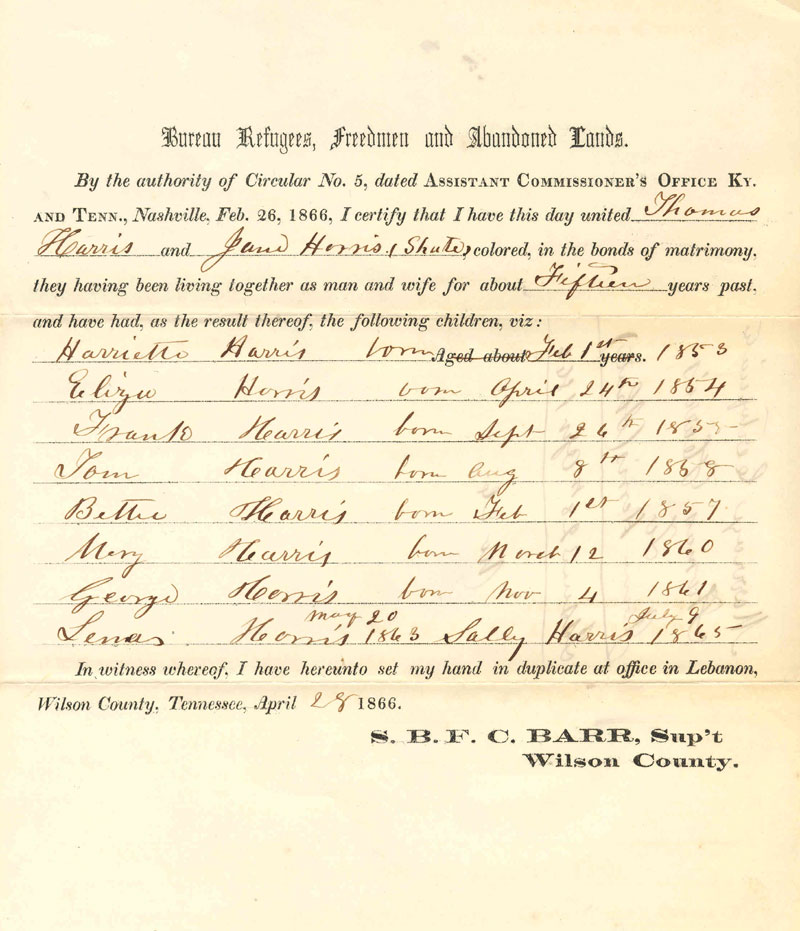 |
| Despite living as man and wife for fifteen years and having nine kids, the marriage of Thomas and Jane Harris was not legally recognized until 1866. (National Archives) |
The records of the Freedmen’s Bureau could certainly be a valuable source of research for those interested in the era of the Civil War and Reconstruction. It could also be a great genealogical tool, as Stevens herself is using it to try to trace her family history.
The final piece of advice from the presentation was to consult the National Archives page on the Freedmen’s Bureau as well as a finding aid created by the office in Atlanta to check out which states have which records. Although active throughout the South, the records of the Bureau varied by state.
Overall, the presentation was insightful and made potential research in the Freedmen’s Bureau records seem a little less daunting. Of course, those eager to jump right in with a visit to the National Archives office in Philadelphia will have to wait, as they are preparing to move to a new location.
Thursday, May 29, 2014
Congrats, Newly Minted History Masters!
 |
| Some very excited grads! Back, L-R: Bryan Shinehouse, Andrew Coons, Hayley Stevenson, Alex Langer, Brian Gallagher, Kent Weber. Front, L-R: Joseph Jasinski, Alicia Parks, Haddi Bergstrom, Joanna Voortman, Eileen Brumitt. Photo courtesy of Eileen. |
On May 17, twenty-one grad students made the transition to official Masters of History.
Alex Langer
Alicia Parks
Andrew Coons
Bill Gay
Brian Gallagher
Bryan Shinehouse
Colin McNulty
Eileen Brumitt
Gary Flavion
Grant Carter
Haddi Bergstrom
Hayley Stevenson
Jeremy Angstadt
Joanna Voortman
Joseph Jasinski
Kent Weber
Maria Savini
Pat Madden
Pat Moore
Robert Miller
Rusty Beckham
Congratulations and best of luck in your future endeavors! You will be greatly missed in class, around the department, and in general.
Tuesday, May 27, 2014
Reformatting in Progress
We will be reformatting over the next few days. Please bear with us as we transition to a design inspired by the WWI centenary.
Sunday, May 4, 2014
Civil War Students (and Matt) Visit Gettysburg
On Friday Professor Giesberg took a group of students to tour Gettysburg National Military Park.
The trip started with a battlefield tour from a National Park Service ranger, who showed us around the park while narrating the buildup and three days of the battle. He also gave us histories of some of the many monuments of the battlefield, highlighting the importance of memory and politics in the ways we commemorate events.
The group then got a tour of Culp’s Hill from Peter Carmichael, Director of the Civil War Institute at Gettysburg College. Professor Carmichael showed us where some of the bloodiest fighting of the war took place, as well as the locations of several Confederate mass graves. He also shared stories from his research on how common soldiers experienced the battle and understood loyalty to army and country.
The day ended with a trip to the Visitor Center. Here the group saw the film A New Birth of Freedom, viewed the Gettysburg Cyclorama, and went through the Gettysburg Museum.
Overall the trip was a great experience. In addition to a last hurrah for a number of graduating students, the terrific battlefield guides offered new perspectives for thinking about not only the battle, but the ways we study history and memory. Perhaps the only thing that could have made the day better was if we had seen a ghost, but no such luck.
Special thanks to Professor Giesberg for organizing everything and for driving, as well as the History Department for funding the trip.
The trip started with a battlefield tour from a National Park Service ranger, who showed us around the park while narrating the buildup and three days of the battle. He also gave us histories of some of the many monuments of the battlefield, highlighting the importance of memory and politics in the ways we commemorate events.
The group then got a tour of Culp’s Hill from Peter Carmichael, Director of the Civil War Institute at Gettysburg College. Professor Carmichael showed us where some of the bloodiest fighting of the war took place, as well as the locations of several Confederate mass graves. He also shared stories from his research on how common soldiers experienced the battle and understood loyalty to army and country.
 |
| Group at Culp's Hill with Peter Carmichael (Photo by Dr. Judy Giesberg) |
The day ended with a trip to the Visitor Center. Here the group saw the film A New Birth of Freedom, viewed the Gettysburg Cyclorama, and went through the Gettysburg Museum.
 |
| And posed with a familiar face. (Photo by a stranger, but with the camera of Dr. Judy Giesberg) |
Overall the trip was a great experience. In addition to a last hurrah for a number of graduating students, the terrific battlefield guides offered new perspectives for thinking about not only the battle, but the ways we study history and memory. Perhaps the only thing that could have made the day better was if we had seen a ghost, but no such luck.
Special thanks to Professor Giesberg for organizing everything and for driving, as well as the History Department for funding the trip.
Tuesday, April 29, 2014
Graduate History Research Recognized
 |
| A whole slew of History folks! Standing, L-R: Dr. Adele Lindenmeyr, Graduate Dean; Dr. Alexander Varias, Faculty Editor; Dr. Marc Gallicchio, research advisor; Dr. Rebecca Winer, research advisor; Alexander Langer, author. Seated, L-R: Laura Layne, Peer Reviewer; Alexandra Webster, Student Editor; James Holmes, author and Graduate Research Essay Prize recipient; Dr. Judith Giesberg, History Graduate Program Director; Dr. Whitney Martinko, research advisor. Not pictured: Jennifer Putnam, author. |
- In print:
- James Holmes, "'I Trust the Gospel and All its Contents': The Disputation of Jirji the Monk and Medieval Islamic Knowledge of the Bible". James also received the Graduate Research Essay Prize. Dr. Rebecca Winer advised his research.
- Online:
- Jennifer Putnam, "NAGPRA and the Penn Museum: Reconciling Science and the Sacred". Dr. Whitney Martinko advised her research.
- Alexander Langer, "Dr. No and Dr. Strangelove: Cold War Anxiety in Film, 1962-1964". Dr. Marc Gallicchio advised his research.
History students and faculty were also involved in the reviewing and editing process.* Alexandra Webster served as a student editor. Laura Layne served as a peer reviewer. In addition, Dr. Alexander Varias served as a faculty editor.
Copies of Concept will be distributed around the department, so pick one up to see what your colleagues have been working on.
*If I missed anyone, please leave a note below.
Monday, April 28, 2014
Congratulations to the Woodlands Researchers
Last Thursday the members of Professor Martinko’s Practicum
class presented their research on the Woodlands Mansion in Philadelphia. The
event drew a crowd of Villanova students and faculty, as well as a fair number
of interested locals.
| Nineteenth Century Print of the Woodlands Estate (Falvey Memorial Library) |
Spread throughout the house and grounds, the students
presented on the laborers and servants who inhabited the estate. From a variety of manuscript materials the class gave voice to the
men and women whose lives were lost over time. From the stable hands and
greenhouse laborers to cooks, laundresses, and house servants, the students
painted a picture of an active estate and shed light on what we can learn from
historic landmarks.
Hats off to Professor Martinko’s Practicum class for the hard work they put into their research and presentations of the Woodlands. I know I was not the only one to learn something about an under-appreciated Philadelphia landmark, and their efforts helped set a foundation for further research into a historic estate.
Monday, April 21, 2014
Vintage YouTube: British Pathé Uploads its Archives

On April 17, British Pathé made 85,000 historical movie clips and videos available on its YouTube channel. The footage spans nearly a century, from the 1890s through the 1970s. It includes anything from major news headlines, like the Hindenburg disaster and the death of Marilyn Monroe, to more slice-of-life snippets of Western culture, like a clip on a French flea circus from 1949 ("Next time, don't forget the DDT," the narrator reminds us). The archive is also particularly strong in WWI and WWII footage.
In an interview on British Pathé's blog, Alastair White, general manager of the London-based media company, expressed his hopes that the project will bring history to a broader audience: “Our hope is that everyone, everywhere who has a computer will see these films and enjoy them...this archive is a treasure trove unrivalled in historical and cultural significance that should never be forgotten. Uploading the films to YouTube seemed like the best way to make sure of that.”
Of course, historians recognize that while film can be a valuable source, it is also a potentially problematic one; viewers may be apt to see film as more objective, if not naked in its honesty. British Pathé has given the world a highly valuable resource, yet its assertion that the clips should "never be forgotten" seems a vague and ambiguous goal. Is it enough that this footage is simply out there for entertainment and enjoyment? Is it a good first step, at least? How can historians capitalize on it?
On a final, less serious note, YouTubers seem apt to use historical footage for inventive, entertaining purposes. Two of my personal favorites are "Roots of Breakdance", starring Soviet soldiers backed by Run DMC, and "Hitler Sings 'The Jeffersons' Theme", which syncs Triumph of the Will footage with the theme song of the popular American TV show. The British, coincidentally, were a bit ahead in 1941 with their comedy reel "Schichlegruber Doing the Lambeth Walk (Assisted by the Gestapo Hep-Cats)". If there is any historical constant, it seems to be our need for humor now and again.
If you have used film footage in your research and/or teaching, please share your experiences with us. And feel free to share your favorite historical (original or creatively modified) videos as well.
Friday, April 18, 2014
1964 New York World's Fair, 50 Years Later
To commemorate the fifty year anniversary of the 1964 New York World's Fair, the New York Times sought pictures and interviews from those who were there.
Check out the article here to read about the memories of those who witnessed the Fair firsthand, experiencing Belgian Waffles, transportation of the future, and even an animatronic Abraham Lincoln.
The next world's fair, Expo 2015, is scheduled for next year in Milan, Italy. What celebrations of the present and future should we expect?
 |
| New York Times |
The next world's fair, Expo 2015, is scheduled for next year in Milan, Italy. What celebrations of the present and future should we expect?
Thursday, April 10, 2014
Possible Postgraduate Career - Tattoo Quality Control
This week's cover of Rolling Stone features Julia Louis-Dreyfus with the United States Constitution printed on her back. But there is a rather embarrassing error.
 |
| Rolling Stone |
Do you see their mistake?
Need a hint? Check out this article from the Philadelphia Daily News, which includes a response from the National Constitution Center.
Thursday, April 3, 2014
Villanova Students to Present Research on Local Historical Site
 |
| visitphilly.com |
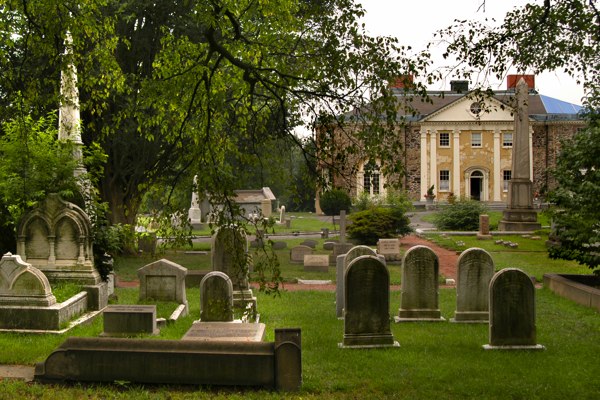
Fortunately, a group of Villanova grad students have been spending the Spring Semester researching the history of the mansion and grounds, as well as those who lived and worked there. On the evening of April 24 they will be at The Woodlands sharing their discoveries about the site.
If are looking for a break from research papers, this is a great opportunity to come out to support grad students and learn more about the rich history of Philadelphia.
More information about the tours here.
Are you a student participating in this research project? We would love to get a sneak preview of some of the things you have been working on.
Wednesday, March 19, 2014
History Students to Present at Villanova's 25th Annual Elizabeth Cady Stanton Conference
On Friday, April 4, Villanova University will host its 25th annual Elizabeth Cady Stanton Conference. The conference highlights research from a variety of disciplines, all connected by a focus on gender/women. Everyone is invited and encouraged to attend.
Six* of our History M.A. students will present at the conference:
Haddi Bergstrom, "Feminization of Religion: Discourse and the Cult of the Domestic in 18th and 19th Century France"
Grant Carter, "Revolutionary Women: 1848, The Paris Commune, and Revolutionary Opportunities"
Shane Sprandio, "Cultural Memory: Anita Garbialdi in Literature and Art"
Hayley Stevenson, "The Cult of the Clitoris: British Imperial Culture and the Sexually Liberated Woman"
Christina Virok, "Heroine, Rhetorical Device, or Symbol of Conquest?: Examining Depictions of Muslim Women in the Literature of High Medieval France and England"
Alexandra Webster, "Second Among Equals: Gender and the 'Double Burden' in Soviet Female Enlistees' Great Patriotic War Memoirs"
*If I missed anyone, please let me know!
Tuesday, March 4, 2014
A Spectre Still Haunting: How Interrogating the Historically Inspired Rhetoric of the Ukrainian Crisis Can Help Us Be More Mindful Historians
Words are deceptive. The existence of the dictionary, years of vocabulary exercises in our youth, and verbal GRE study cards suggest a stable, definite quality to our lexicon. But “words,” as Slavoj Žižek reminds us, “are never ‘only words’.” Words are neither static nor amorphous ‘things’, but nebulous and contested political, cultural, social, and historical spaces. Words are not unlike a UFC match, where the ring’s cage-like barriers are seemingly fixed, but realistically flexible and sometimes violently permeable. Within the ring, the forces of politics, culture, and society duke it out for the win: the power to manipulate and redefine the word to suit their respective purposes. Sometimes, one champion reigns; other times, he becomes displaced. The cycle is continuous and uncertain. And it all occurs in front of a cheering and jeering audience that assesses and interprets the events playing out before them in myriad ways based on loyalties, desired outcomes, and the power of suggestibility.
A few weeks ago, Anne Applebaum wrote an article for Slate showcasing the “smears,
stereotypes, and clichés” commonly used in Ukrainian and Russian media and political rhetoric to define the
crisis in Ukraine. Applebaum lists seven of the most common: ‘fraternal assistance’, ‘anti-terrorist operation’, ‘coup d’etat’,
‘Nazi', 'fascist’, ‘ethno-linguistic divisions', and 'Yugoslav situation’. Each has exceptional emotionally,
culturally, and historically loaded connotations in Ukrainians' and Russians' living
memories. Applebaum further illustrates
how these words and phrases are being re-purposed and utilized by a variety of
politically-minded groups to rally popular support for themselves or popular
antagonism against their ideological, social, and political foes, primarily through emotional pandering. As the crisis deepens, these terms will become even
more slippery and continue to transfigure and metamorphose.
But this Frankenstein-esque reanimation of words and phrases is
not limited to Ukraine and Russia. Western rhetoric is also complicit in constructing
analogies and pandering to emotions based on national and cultural historical memory. John Baird, Canada’s Foreign Affairs Minister, called Russia’s troop presence in Crimea “straight out of the Cold War.” An op-ed piece in the New York Times referenced the threat
Russia potentially poses to the “post-Soviet world”. More recently, Western politics and media have been inclined toward a ‘Crimea as the new Sudetenland’ analogy, apparent in Baird’s
interview and King’s piece. The Huffington Post and The Australian also ran articles with this analogy at the forefront. And then there
are the oft-referenced bits about ‘democracy’ and ‘freedom’, the ultimate American stereotypes and clichés. This is perhaps best illustrated by US Secretary of State John
Kerry's assessment of the Ukrainian mood during his recent visit to Kyiv: “It is universal, it is unmistakable,this call for freedom.” Yet Ukraine’s provisional government’s attempted elimination of a law allowing official
representation of regional, minority languages is a keen example of how words are politically and culturally constructed
battlegrounds. It begs the question of what, exactly, ‘freedom’ and 'democracy' mean in this context, and to and for whom.
“Words matter,” as Žižek reiterates.
It is often said that the past informs the present. But we can also use the present to
reflect upon the past in our work as historians. In
your own research, how much attention do you give to words, their meanings, applications, and intents -- and the nuances within those spaces? How often do
you consider what words mean in a specific context or source? How conscious are you of your own cultural
associations and biases against a word or phrase? How much thought do you give to the
historical and/or cultural distance between yourself and the word you’re trying to define? Have you ever discovered indeterminateness in the use and meaning of words and phrases where you expected stability?

Sunday, February 23, 2014
Alumni Spotlight: Tom Foley
The first graduate in our ongoing series "The Real World: Villanova History" is Tom Foley. Tom, a 2013 graduate, is currently at Georgetown University pursuing his doctorate in history.
Are you or do you know a Villanova graduate willing to offer advice to fellow Masters students? Please contact us, and we would love to be in touch.
Tell us a little about your academic background and interests.
[Note: Tom failed to mention that he did his undergraduate work at Notre Dame. As a fellow Domer I think it is my obligation to point that out.] I graduated from the M.A. program in history at Villanova in 2013. Prior to starting the program in 2011, I worked in a legislative research office within state government. While at Villanova, I had the good fortune of working on the Emilie Davis Diaries project led by Dr. Giesberg. It is difficult to overstate the value of that experience, which continues to inspire my historical interests.
What are you up to now?
I am a first-year doctoral student at Georgetown University and am studying 19th century United States history with a focus on the intersection of gender and politics in the Civil War era. I am also interested in the history of energy and the environment, digital public history, and the relationship between history and literature.
How did your experiences at Villanova prepare you for a PhD program?
The rigorous coursework and high standard to which faculty hold students challenged me and pulled me from familiar themes. The passion for history among students and faculty was always palpable, and keeping that fire stoked and well-fueled is essential in all graduate studies.
What advice do you have for current Masters students also considering pursuing a PhD?
If you are considering a PhD program in any field, consider developing your language skills. Most PhD programs require an advanced level of competency. For example, at Georgetown, all students must pass one language exam and all those in non-U.S. fields must pass at least one additional language that pertains to their research. Many excellent opportunities exist at Villanova and throughout the Philadelphia area to build your language skills.
Additionally, contact faculty members and current graduate students at PhD programs that interest you. Talk to your Villanova professors, as they can often provide a valuable introduction to a former colleague, classmate, or student. It is vital not only to obtain a good understanding of what the program offers, how it perceives itself, and how it survives and thrives within the university community. Email and then visit the programs and people you are drawn to, if practicable. The worst that can happen is your email (and follow-up email) goes unanswered in which case you have still learned something valuable about that program.
Finally, edit, edit, ask others to read and review, and edit all essays, applications, and even emails you send to potential programs. In other words, continue to practice being good scholars!
Special thanks to Tom Foley for taking the time to answer a few questions and provide advice to students following in his footsteps.
Have more questions for Tom? Contact him here.
Are you or do you know a Villanova graduate willing to offer advice to fellow Masters students? Please contact us, and we would love to be in touch.
Thursday, February 20, 2014
Downton vs. du Pont: A look into the historical costumes of Downton Abbey coming soon to Winterthur
 When I was first introduced to Downton Abbey I
spent an entire day watching episodes until I was thinking in a British accent and
staring at my empty bottle of wine wondering where my bell was to call up Mr.
Carson to fetch me another. From the moment Maggie Smith’s character, Countess
Violet Crawley, in the very first episode, uttered the words, “What are
week-ends?” I knew I was hooked. While many of us are still trying to cope with
the loss of Mary and Matthew’s love scenes, Winterthur Museum, owned by the du
Pont family, has managed to bring a bit of our love for the iconic show to
their historic home in Delaware.

Beginning March 1, 2014, forty of
the best fashion moments from Downton will be on display at Winterthur. While the styles are not completely historically
accurate it is interesting to view the contrasts between styles of the early 20th
century with their modern influences. The creators of Downton actually took
vintage fragments of garments and incorporated them with new fabric in order to
create the styles seen on the show. As a historian the exhibit offers a chance
to contrast American High Society to the Downton way of life. English
aristocracy of the 1920’s and 30’s seemed to have an aversion to new technology
and ways of life, and this is a constant theme in the show as Mrs. Patmore, the
cook, continues to argue that she likes the way things are and she does not appreciate
the new technology bugging her in the kitchen. The opposite was true for the du
Pont family as modernity and comfort were central in the creation of Winterthur
during the same time period. Unlike Downton, Winterthur boasted an elevator and
telephones as well as refrigerators and a heated swimming pool. In addition,
the exhibit will also host a number of costumes worn by the staff at Downton as
well as the staff at Winterthur to see how each were an integral part of the
families lives.
 The fashion on display at
Winterthur ranges from breakfast attire, to staff outfits, to evening wear.
There will also be the more memorable looks such as Lady Sybil Crawley’s blue
harem outfit, and Matthew Crawley’s tweeds and that adorable jeff cap. I mean
is there anything better than a nice Matthew outfit? I digress on the outfits;
yet if this all sounds as wonderful to you as it does to me then visiting
Winterthur should be your next stop in learning more about the early 20th
century fashion and lifestyle. Lastly, if you have been living in a bubble and
have no idea what I am talking about I suggest you go buy a bottle of wine
(priorities first), and find Downton
Abbey pronto in order to view a very successful drama on English Society during
the post-Edwardian era.
For more information please visit the Winterthur website
Monday, February 17, 2014
A New Mount Rushmore for Presidents' Day
Ever wonder what a revised Mount Rushmore might look like?

(Funny or Die)
No, not this revised view.
To honor Presidents' Day, Franklin's Opus asked a panel of historians, including Villanova's own Professor Marc Gallicchio, to rank America's Presidents on faithfulness to the Constitution, promotion of liberty, and leadership.
Check out the results of the survey. Who made the new Mount Rushmore? Who would you have put on the monument?
Also, think you know Presidential trivia? Check out their Presidents' Day Quiz to find out!
Saturday, February 15, 2014
The Real World: Villanova History [Coming Soon]
Life after the M.A. might seem like a scary and uncertain place, especially for those on the cusp of graduation. What happens to Villanova's History M.A. grads? What awaits them once they cross that stage, shake the diploma-issuing hands of fate, flip their tassels in a final conversion, and ride off into the sunset, sometimes for places and purposes unknown?
Now you can find out.
"The Real World: Villanova History" will be a series of interviews with program alums. The feature aims not only at introducing current students to a broad range of possibilities for their education, skills, and interests, but at providing them with opportunities to connect and network with former students as well. We will try to concentrate on fairly recent grads: those who missed being current students' colleagues by a few years. Current students may even see a few familiar faces.
Stay tuned in the following weeks for our first interviews.
Are you an alumna or alumnus interested in being interviewed about your life post-'nova? We'd love to chat with you! Please contact us here.
Wednesday, January 29, 2014
Help Wanted: Assistance Hiring a Historian of Modern China
 |
| Source: NPR |
Please see below for presentation days and times. Since it is department policy to avoid publicly disclosing the identities of candidates, their names, backgrounds, and presentation titles have been omitted. Candidate and presentation details will be emailed and posted on fliers around the department, though, so keep an eye out next time you're on campus.
Candidate A, Thursday, 1/30, 4:30, Bartley 1010.
Candidate B, RESCHEDULED: Thursday, 2/6, 4:30, Wright Room, Palomar Hotel, 117 S 17th St. in Philadelphia
Candidate C, RESCHEDULED: Friday, 2/14, 2:30, Falvey 205
Candidate D, Monday, 2/17, 4:30, Bartley 1010.
Tuesday, January 28, 2014
A History of White Manliness, As Told by Facial Hair
Even a cursory study of 19th century American History, especially during the Civil War era, will demonstrate the period as one of epic facial hair. Take Valentine Tapley for example:

(Franklin's Opus)
Tapley, a Missouri Democrat, swore that he would never shave again if Abraham Lincoln was elected President in 1860. True to his word, Tapley died in 1910 with a beard more than twelve feet long.
Recently, The Atlantic ran a story about the history of facial hair in 19th century America. While not every beard of the era was as explicitly political as Tapley's, the author, a Penn State doctoral candidate in History and Women's Studies, contends that the widespread embrace of facial hair grew from a concern about the increasing influence of African American barbers. Beards eventually became a "manly appendage" as a show of dominance against the growing women's rights movement and in military campaigns against foreigners and Native Americans.
Check out the article. Do you buy that the rise of facial hair was a "symbol that set white American men apart from smooth-faced foreigners as well as powerful women?" How can trends in appearance shape our thinking about history?
Special thanks to Professor Giesberg for sharing this article.
Wednesday, January 15, 2014
German Society History Lecture Series
In 2014, the Joseph
Horner Library at the German Society of Pennsylvania is hosting a lecture series from distinguished scholars in German-American history. Villanova graduate
students interested in topics related to German history and culture are welcome
to attend. Here is the list of all the history-related events happening at the
GSP this year:
January 23, 2014: Dr. Friederike
Baer (Assistant Professor, Department of History, Penn State University
Abington), German-Americans, Nativism, and Murder: The Trials of
Paul Schoeppe, 1869-1872
February 19, 2014: Dr. Randall
Donaldson (Associate Professor, Department of Modern Languages and Literature,
Loyola University Maryland): The German Societies of
Pennsylvania and Maryland: Two Perspectives on German-Language Immigrants to
North America
March 20, 2014: Dr. Jürgen Overhoff (Professor,
Institut für Erziehungswissenschaft und Historische Bildungsforschung,
Universität Münster): William Penn’s Travels in Germany, 1677
May 22, 2014: Dr. Lynne Tatlock (Professor,
Department of Germanic Languages and Literatures, Washington University at St.
Louis): German Romance in America: The Translations of Annis Lee
Wister and the Americans who read them (1868-1907)
June 14, 2014: Dr. Birte Pfleger (Associate Professor,
Department of History, California State University Los Angeles): The
Other Germans: German-Speaking Veterans of the Revolutionary War, 1775-1840
Lisa
Minardi (Ph.D. student, History of American Civilization, University of
Delaware and President, The Speaker’s House): From Pastor to
Patriot: Frederick Muhlenberg, Lutheran Minister and First Speaker of the U.S.
House
Dr.
Bethany Wiggin (Associate Professor, Department of Germanic Languages and
Literatures, University of Pennsylvania): Printer-Publisher Christoph Sauer (the Older),
Separatism, and the Founding of the German Society of Pennsylvania
December 10, 2014: Dr. Frank
Trommler (Professor Emeritus, Department of Germanic Languages and
Literatures, University of Pennsylvania): Germany’s Cultural
Diplomacy in the 20th Century: Not a Topic for Diplomats
Tuesday, January 14, 2014
Prospective Graduate Form Deadline!
This is a reminder to any graduate students hoping to graduate in Spring 2014 that Wednesday, January 15th is the last day to fill out the online Prospective Graduate Form. The form can be accessed through the student tab in myNova.
Thursday, January 9, 2014
Exploring the Graduate Study Lounge
Welcome
back!
The start of the semester means hitting the ground running with studying, researching, and writing. Many trainee historians choose the convenience and silence of Falvey Library for this purpose; others spend their time in the more bustling Rofinot Lounge. But if you’re looking for a change of scenery from your standbys, consider checking out the new Graduate Study Lounge.
- Lounge or Lodge? The Lounge is located in Old Falvey 306. Though not ‘masons-level in its exclusivity and security, the Lounge does require a swipe of your Wildcard at the door.
- A roost for night owls. One of those midnight oil burners who works better at 2am than 2pm? Made a pact with yourself that you can’t go home until you’ve read The Making of the English Working Class in its entirety? If you somehow find yourself on campus in the wee hours, have no fear: the Lounge is accessible 24 hours a day, 7 days a week.
- Enjoy the silence. Grad school is serious business, and the pin-drop atmosphere of the Lounge ensures the satisfaction of those who need a quiet space to study. Don’t let this dissuade you, however, if you’re looking to study with friends or plan a joint presentation: the Lounge is also intended for collaborative study and work.
- Let there be light. If you've spent enough time in Rofinot, you've surely experienced at least one well-intended professor asking why you're sitting in the dark before switching on the light, turning you to dust every time. If you’re worried that you might be becoming irreversibly photosensitive or vitamin D deficient from your time in the dimness, especially in these winter months, the Lounge’s numerous windows allow you to sop up a generous amount of the sunshine vitamin.
- Don’t get too comfortable. Actually, go right ahead. The large, comfy chairs are perfect for those who have reached the final level of multitasking: power-napping and studying.
- Stick it to the Cobalt Letter. Old Falvey is a mere hop, skip, and jump away from Falvey Library, where grad students often emerge with brimming Falvey totebags slung across their shoulders, those bulky cobalt letters -- passports into regions where other students dare not to tread -- marking their lot in Villanova’s scholarly community. Fortunately, the Grad Lounge offers a number of lockers rentable for 24 hour periods. So whether you’re looking to go incognito or relive your adolescence, feeling what can be done today can be put off until tomorrow, or simply wanting to give your back and shoulders a break, the Lounge might be the place for you.
Graduate
Study Lounge: Old Falvey 306. Open
24/7. Access with Wildcard.
Wednesday, January 8, 2014
Graduate Happy Hour
Wary of your winter recess goal
to become the next Zarathustra? Consider
breaking from your anchorite quest and come down from the mountain to socialize
with your fellow grad students.
The Graduate Student Council and
Villanova SHRM (Society for Human Resource Management) have teamed up to host a
Graduate Happy Hour on Tuesday, January 14, at Gullifty’s in Bryn Mawr. The Happy Hour runs from 5:30-7:30. There will be free appetizers and drink
specials. Come hang out with old friends
and make some new ones. It's certain to be a smashing time for all (and none).
For your GPS: 1149
E Lancaster Ave, Bryn Mawr, PA 19010.
Subscribe to:
Posts (Atom)